


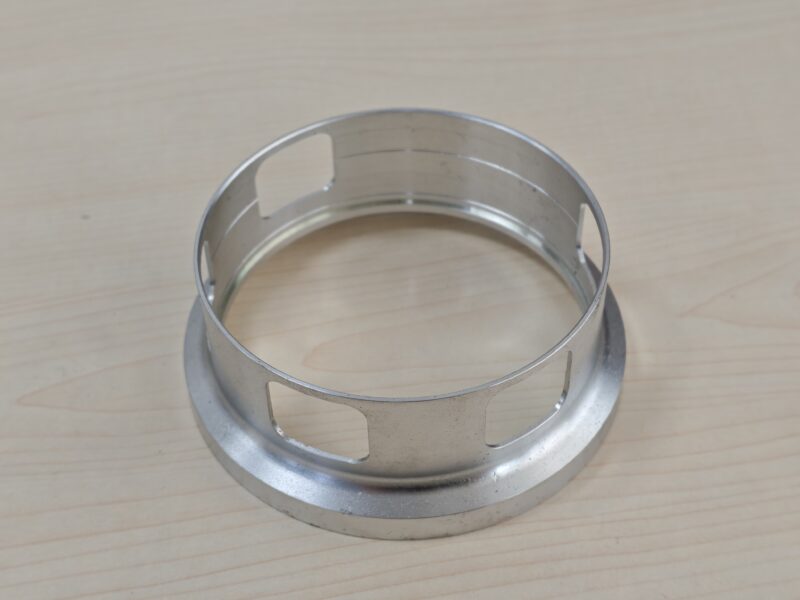
Precision Aluminum Alloy Flange Ring
Product Processing
Cycle Time: 10-15 Days
Time Breakdown & Key Factors:
Programming & Setup (1-2 Days): Due to the need for turning-milling composite machining, CAM programming and simulation are required to prevent tool collisions, especially when milling the side wall cutouts.
Precision Machining (5-8 Days): The thin-walled structure requires careful control of cutting parameters to prevent deformation. Roughing and finishing are often separated, and special fixtures are used to ensure the concentricity of the inner and outer diameters.
Quality Inspection (1-2 Days): Verifying the geometric tolerances of the cutouts and the coaxiality of the inner/outer rings requires the use of a Coordinate Measuring Machine (CMM) or specialized gauges.
Surface Finishing (2-3 Days): Includes deburring (critical for the edges of the cutouts), cleaning, and surface treatments such as anodizing or passivation.
Note: The timeline primarily depends on die preparation (if any specific forming tools are needed) and surface finishing processes. If heat treatment (like T6 tempering) is required to relieve machining stresses, this will add approximately 2-3 days to the cycle.
Material: Judging from the luster and texture, Aluminum Alloy (6061-T6) is the preferred choice due to its ease of machining and light weight; if the application environment requires high strength or corrosion resistance, it could also be Stainless Steel.
Turning: The basic shape of the part (outer diameter, inner hole, bottom flange surface) is mainly processed through CNC lathes to ensure extremely high roundness and concentricity.
Milling: The rectangular cutouts on the side wall are completed through CNC milling (or drilling and milling). Since holes are being opened on a thin-walled cylinder, special fixtures are required during processing to prevent part deformation.
Turning-Milling Composite: This part is highly suitable for one-time forming on a turning-milling composite machine, which can ensure the positional accuracy between the flange surface and the side wall holes, while also reducing the number of clamping operations to improve precision.
Product Advantages
Balance between Lightweight and Structural Strength: The hollow design of the side walls removes excess material, significantly reducing the moment of inertia (if it is a rotating part) or overall weight, while retaining the necessary structural support.
High Coaxiality: The rotary structure, after precision turning, achieves extremely high coaxiality between the inner and outer circles, making it highly suitable as a bearing seat, seal ring installation position, or connecting sleeve.
Heat Dissipation and Visibility: The slots on the side allow air circulation to assist in heat dissipation, or allow light/sensor signals to pass through (if it is a sensor mount).
Use Scenarios
Precision Instruments: Used as a lens barrel support for optical instruments, encoder housing, or sensor mounting base.
Aerospace: Used as a stator support for drone or model aircraft motors, or as a lightweight connection ring.
Automation Equipment: Used as a connection flange at robotic arm joints, or as an end cap component for pneumatic/hydraulic cylinders.
Automotive Modification: Similar to a center locking ring for wheels or part of a lightweight pulley.
评价
目前还没有评价