

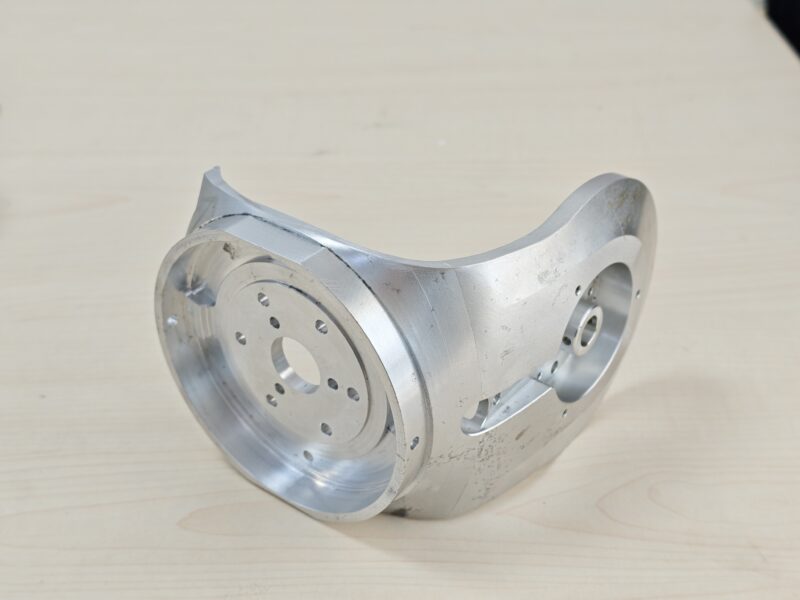
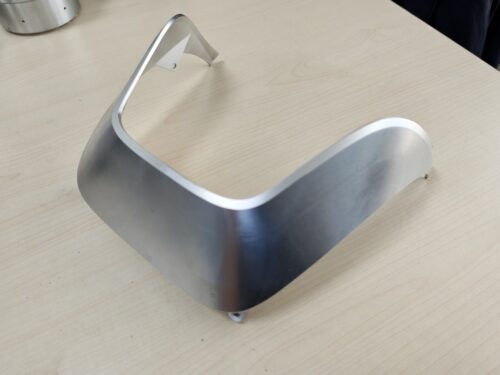
Complex Irregular Aluminum Alloy Housing
Processing Cycle
Cycle Time: 10-15 Days
Time Breakdown:
Programming & Setup (1-2 Days): Due to the complex free-form surfaces, significant time is required for CAM (Computer-Aided Manufacturing) programming and simulation to prevent tool collisions during 5-axis machining.
Precision Machining (5-8 Days): The extensive pocketing and deep cavity milling involve significant material removal. To prevent deformation caused by internal stress, roughing and finishing are often separated, sometimes requiring intermediate stress-relief steps.
Quality Inspection (1-2 Days): Verifying the geometric tolerances of irregular curved surfaces and the coaxiality of bearing seats requires the use of a Coordinate Measuring Machine (CMM), which is more time-consuming than standard caliper measurements.
Surface Finishing (2-3 Days): Includes deburring (critical for complex edges), cleaning, and surface treatments such as anodizing or passivation.
Key Factors Affecting Lead Time:
Heat Treatment: If T6 tempering is required post-machining to relieve stress, this adds approximately 2-3 days.
Surface Requirements: Special coatings or high-gloss polishing will extend the cycle.
Material: 7075-T6 Aerospace Aluminum Alloy is the preferred choice. Given the thin walls and complex structure, the material requires an extremely high specific strength (strength-to-density ratio) and excellent machinability. 7075 aluminum alloy is a top choice in the aerospace industry for its ability to withstand significant mechanical stress.
Equipment: 5-Axis Simultaneous Machining Center.
Mechanical Processing:
5-Axis Simultaneous Machining: This is the core process for manufacturing this part. Due to the complex free-form surfaces and deep cavities, a 3-axis machine cannot access all angles. A 5-axis machine must be used for multi-angle (linkage) milling to maintain the tool orientation and avoid interference.
Precision Boring: The inner holes of the circular seats on both sides require extremely high concentricity and cylindricity, typically achieved through precision boring, and are used for installing bearings or bushings.
High-Speed Milling: For the large-area curved surfaces and thin-walled structures, high-speed milling is employed to reduce cutting forces and prevent part deformation.
Post-Processing: Usually involves T6 heat treatment to relieve machining stresses, followed by chemical conversion coating or anodizing to improve corrosion resistance.
Product Advantages
Extremely High Design Freedom: CNC machining allows for the creation of complex internal channels and irregular appearances that are difficult or impossible to achieve with casting or forging.
Lightweight Design: Through complex topology optimization and pocketing, all unnecessary material is removed, achieving极致 (ultimate) lightweighting while preserving strength along load paths.
High-Precision Fit: Despite the irregular shape, the accuracy of key mounting hole positions can still reach the micron level, ensuring precise assembly.
Use Scenarios
Aerospace: Commonly used in drone fuselage structural parts, aircraft engine brackets, or satellite components, where weight sensitivity is extreme and shapes are complex.
High-End Racing: Used as suspension system brackets (such as wishbone connection parts) or as part of a gearbox housing.
Precision Robotics: Serves as the core joint housing for multi-joint robots, accommodating complex transmission mechanisms.
Optical Equipment: Used as an irregular base for supporting precision lenses or laser emitters.
Reviews
There are no reviews yet.